Wallet-as-a-Service The new financial accounts start here
Run onchain operations and launch financial services, for you and your clients.







How the platform is organized
The platform has five levels, from the institution down to the token balance. Every level is addressable in the API.
-
The contracting institution. It holds every org beneath it and the settings that apply to all of them.
-
A division, legal entity, region or client of the institution. Each org has its own users, credentials and permissions.
-
A group of wallets within an org, separated by purpose or client and sharing one key configuration.
-
A blockchain account derived from a key, with chain access and indexing included. Its tags decide which policies apply.
-
A token or coin balance in a wallet, with its full history indexed.
One wallet to unify every account
Finance runs on many account types, each with its own ledger, intermediaries and hours. A wallet on DFNS does the work of all of them.
Current account
Stablecoins and tokenized cash. Payments settle in seconds, any day of the week.
Deposit account
Tokenized deposits issued by the bank, with interest and maturity built into the token.
Treasury account
Cash and tokenized instruments across entities, in one view and under one set of limits.
Securities account
Tokenized stock, bonds and funds, ownership recorded and subscriptions settled instantly.
Custody account
Keys are held under zero trust security and client assets sit in segregated wallets.
Settlement account
DvP in one transaction, with no settlement cycle and no counterparty exposure.
Correspondent account
Cross-border transfers wallet to wallet in stablecoins, with no pre-funded balances.
Collateral account
Collateral is pledged, valued and released by code, for lending, repo and margin.
Wallets are the new
bank accounts
Wallets that mirror your org chart. Structure wallet fleets by customer, entity, product, or strategy. Every wallet has an owner, a purpose, and a place in your architecture.
Classify wallets by product, segment, geography, asset class, or risk band. Search, audit, and operate groupings of any size.
Isolate wallets by client, entity, or partner. Each environment carries its own users, policies, and controls.
Create, freeze, archive, migrate, and recover wallets via API. Every state change is tracked, assignable, and reversible.
Bitcoin  Ethereum
  Ethereum
  Solana
  Polygon
  Avalanche
 One API for every
business model
Cover every customer relationship from one extensible layer — B2B, B2B2C, B2B2B — without rebuilding the stack.
Group wallets into treasuries, books, portfolios, or master-sub models. Apply policies, reporting, and reconciliation top down.
Provision wallets for your customers, partners, or their users. Embedded in your product, branded as yours.
Isolate clients, roles, and activity down to the key. Bind wallets to users, orgs, sub-orgs, or teams. Govern from the top.
Choose who
holds the keys
Configure wallet control by product, user journey, regulatory model, or operational risk. One platform, every custody model.
Wallets owned by your institution. Run treasury, payments, trading, custody, and settlement under your own keys.
Wallets owned by end users through passkeys, biometrics, hardware, or passwords. Your UX, their keys.
Combine institutional controls, user credentials, and policy enforcement for products that require shared responsibility.
Built for humans,
systems, and agents
Configure how every wallet is accessed and operated. User driven, policy driven, service driven, or fully autonomous, all within the limits you set.
Employees and end users initiate activity through governed authentication and approval flows.
Automations run backend operations like settlement, rebalancing, sweeping, and scheduled processes.
AI transacts under strict permissions, policy guardrails, hard limits, and immutable audit trails.
Discover how Bridge powers global stablecoin payments.
Stripe powers global stablecoin payments and moves billions of dollars around the world for companies like Klarna, Coinbase, SpaceX, Remitly, and Shopify, using DFNS.
Not only did we weather the incident, we came out of it with a healthier, faster, and more reliable system than a week earlier. DFNS was a big part of that.

Run treasury, trading, tokenization, payments, and user flows under one company-wide wallet layer.
Launch wallets in milliseconds. Add new chains in days. Scale from sandbox to millions of accounts.
Every intent must be signed and go through policies, quorums, whitelists, organizations, and more.
SaaS, hybrid, or on-premises. Meet your regulatory requirements without changing the vendor stack.
- 01 · Authenticate
Lock down your perimeter
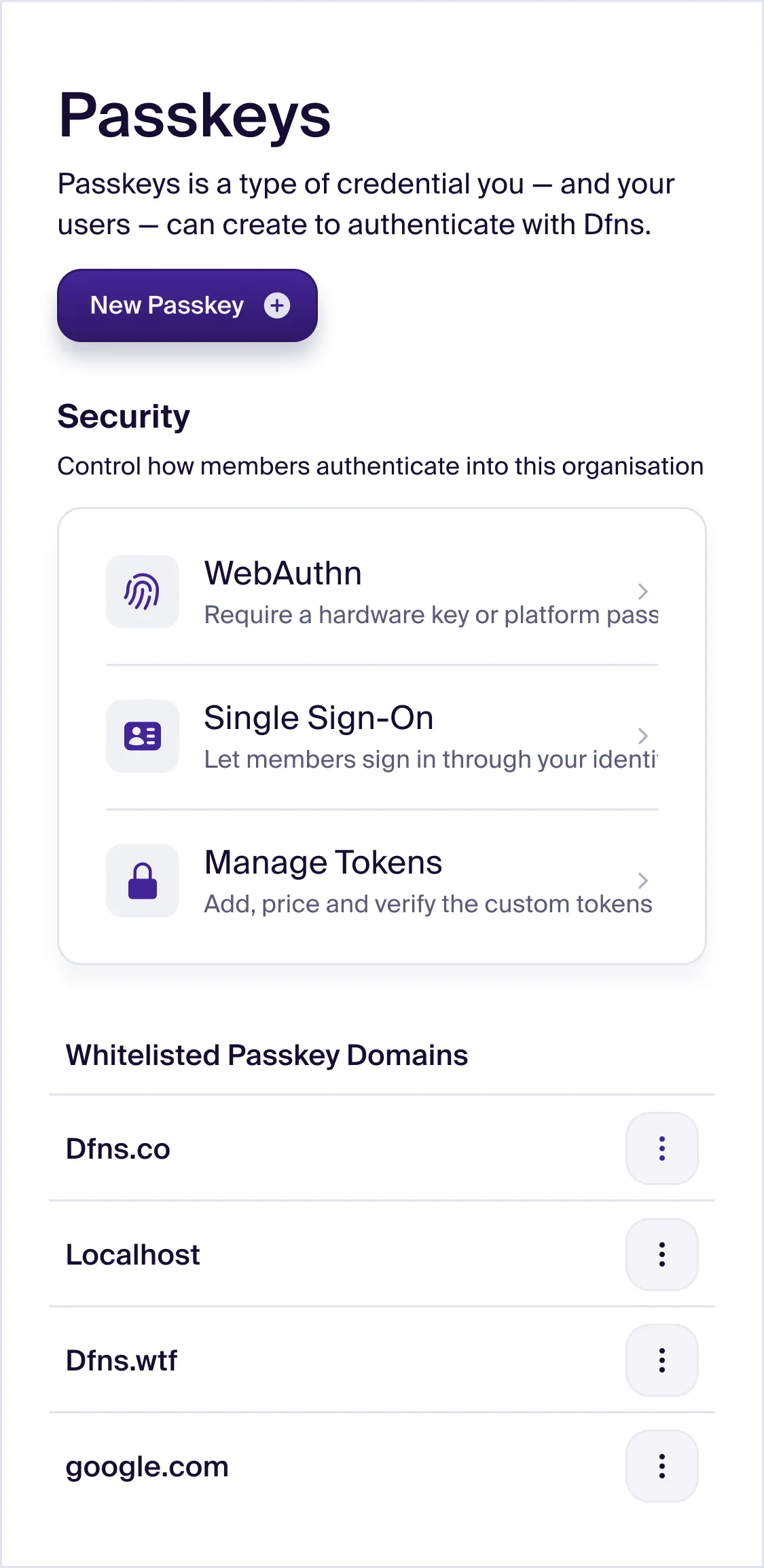
Create a service account. Bind a credential. Scope the permissions. Every request is signed before it touches a wallet.
- 02 · Provision
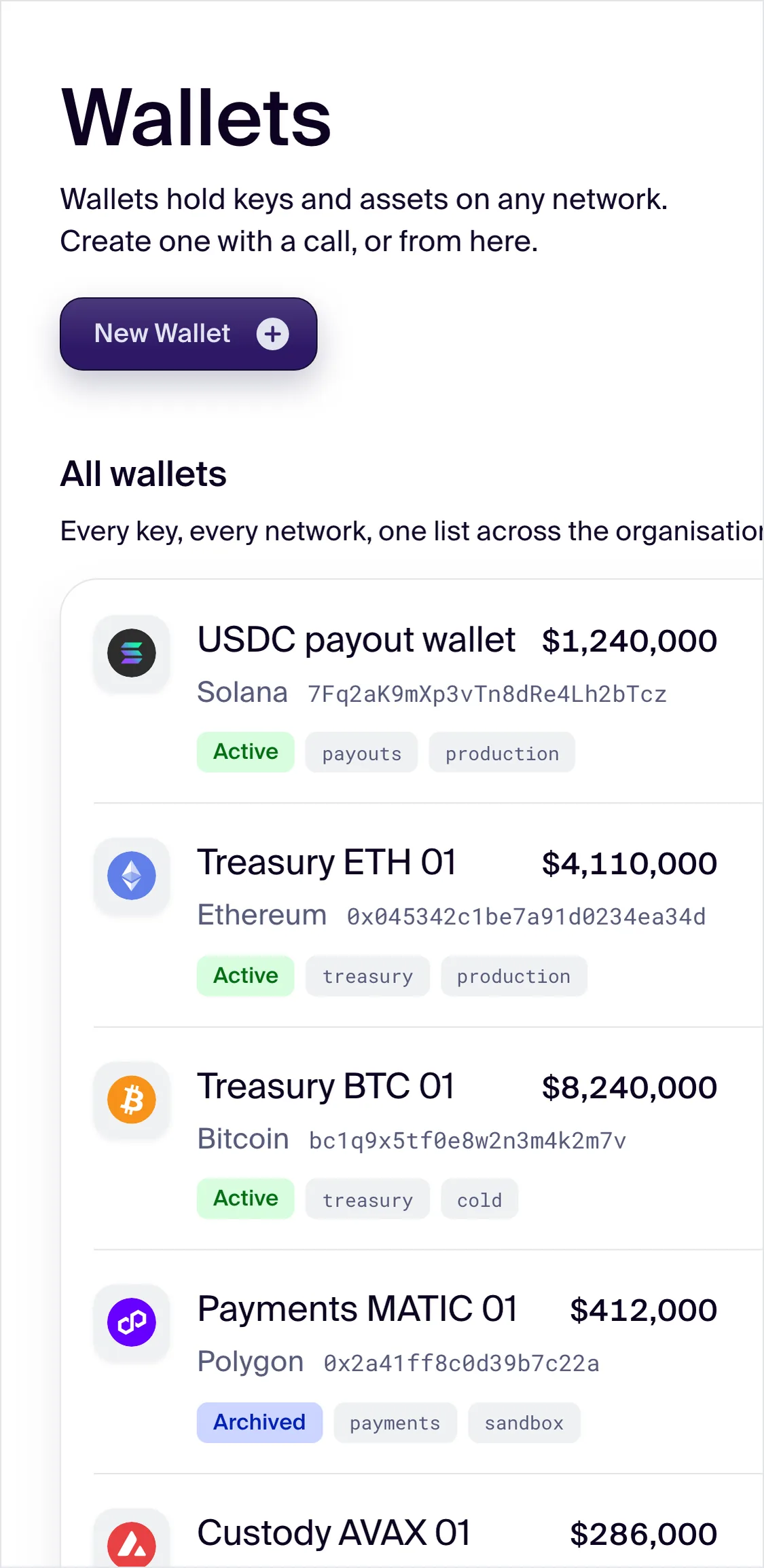
Create your first wallets
One call. Any network. Funded and addressable in under a second. Scale from one to one billion without rewriting a line.
- 03 · Govern
Code in the rules
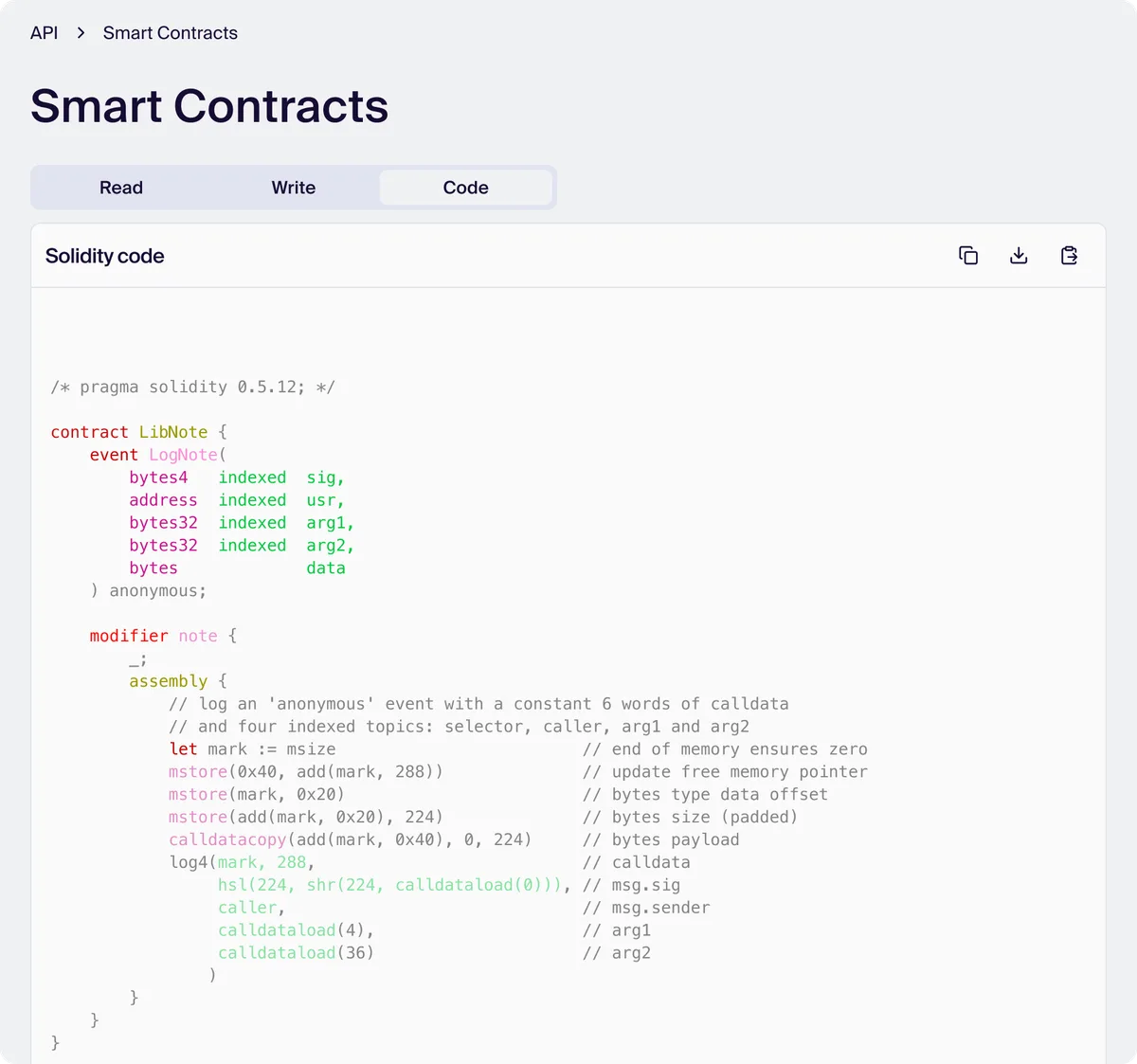
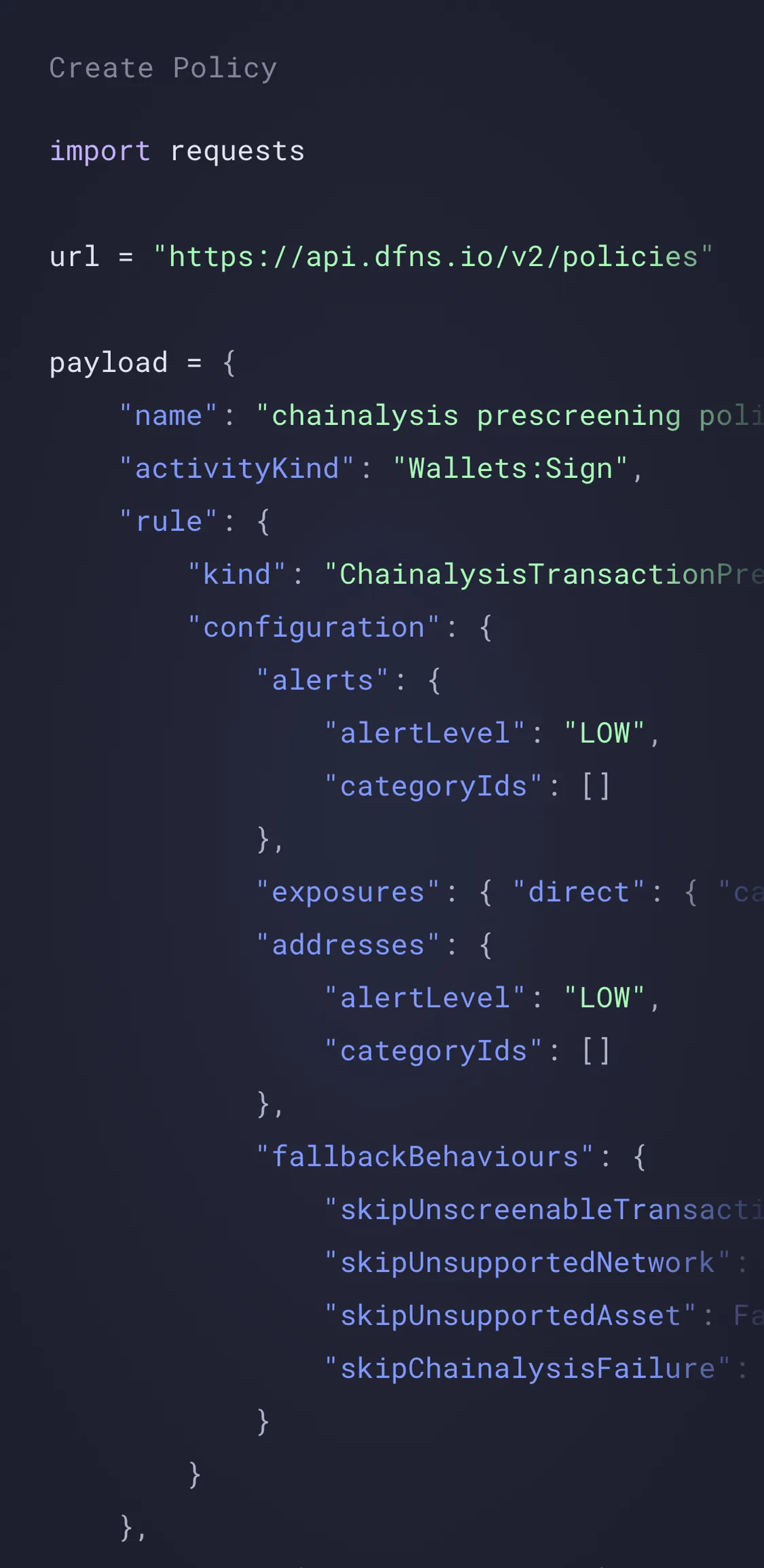
Velocity limits. Address allowlists. M-of-N quorums. ABI-aware checks. Write the policy once. It runs on every wallet that inherits it.
- 04 · Transact
Sign, broadcast, settle
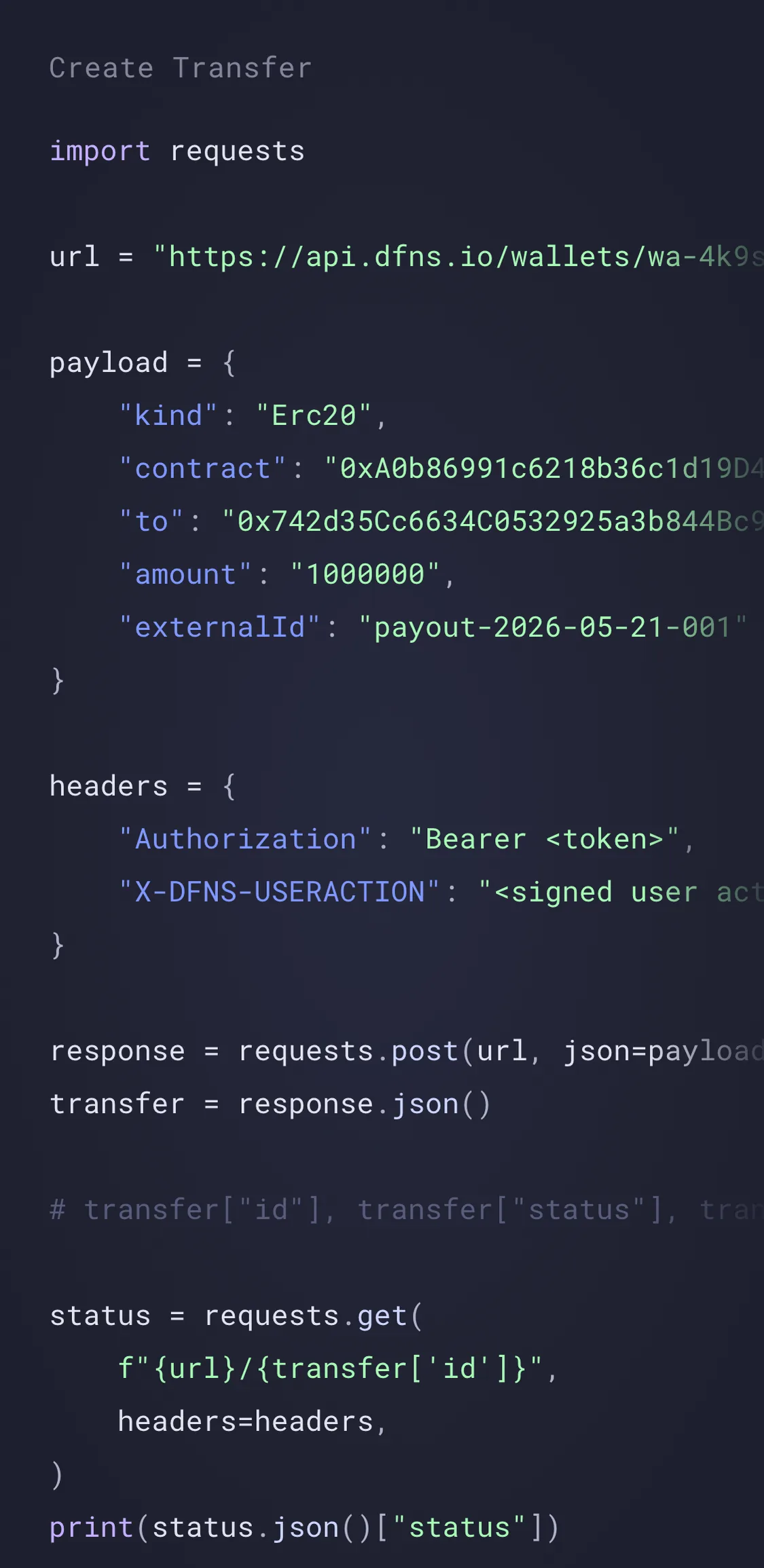
Tracked every step. One call composes, simulates, evaluates policy, collects approvals, signs, broadcasts, and tracks delivery.