 Workflows
 Run financial operations without manual drag
Turn recurring treasury, payment, and admin workflows into governed processes. Automate what is safe. Escalate what needs review.









Service accounts handle the routine. Humans handle the exceptions. DFNS tracks everything that happens in-between.
Every onchain or platform state change fires a signed webhook. Every webhook drives a workflow. No polling, no miss.
No DSL to learn. Decode any ABI, call any HTTP API, query any database, post any decision. The runtime is your stack.
Every action, every approval, every API call, cryptographically signed and logged. Non-repudiation without paperwork.
Build workflows
from real primitives
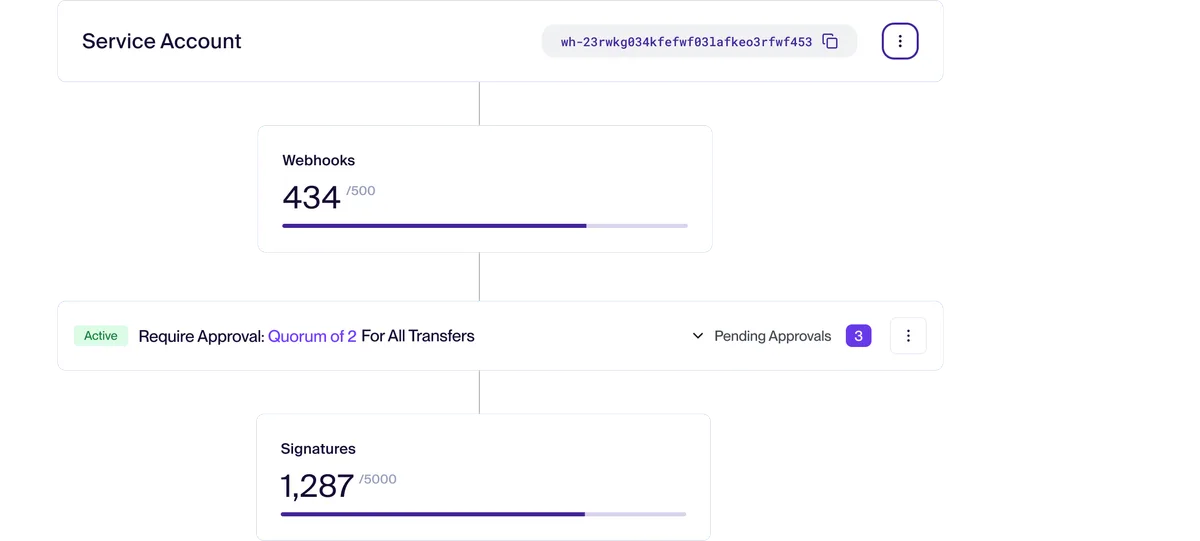
Service accounts, webhooks, policies, every primitive is composable. Wire them together to model anything you do today.
Machine identities with scoped permissions. One per workflow, one per environment. Audited like any user.
Every state change emits a signed, idempotent event. Subscribe once, react forever. No polling, no drift.
All endpoints accept external IDs. Retries are safe. Crashes recoverable. Duplicate requests return the initial response.
Events fire,
workflows run.
Inbound deposits. Pending approvals. Confirmed transactions. Policy violations. Wallet creations. Credential rotations. Every onchain or platform event can drive a workflow. The runtime is yours — DFNS delivers the signal.
Deposit detected, transaction confirmed, contract function called, balance crossed a threshold. Real-time across 100+ chains.
Approval requested, wallet created, policy modified, credential rotated. Operational events, not just transactional ones.
Cron the routine. Sweep balances nightly. Rebalance yields monthly. Close books quarterly. Service accounts execute under policy on the schedule you set.
Programmable approvals,
in TypeScript
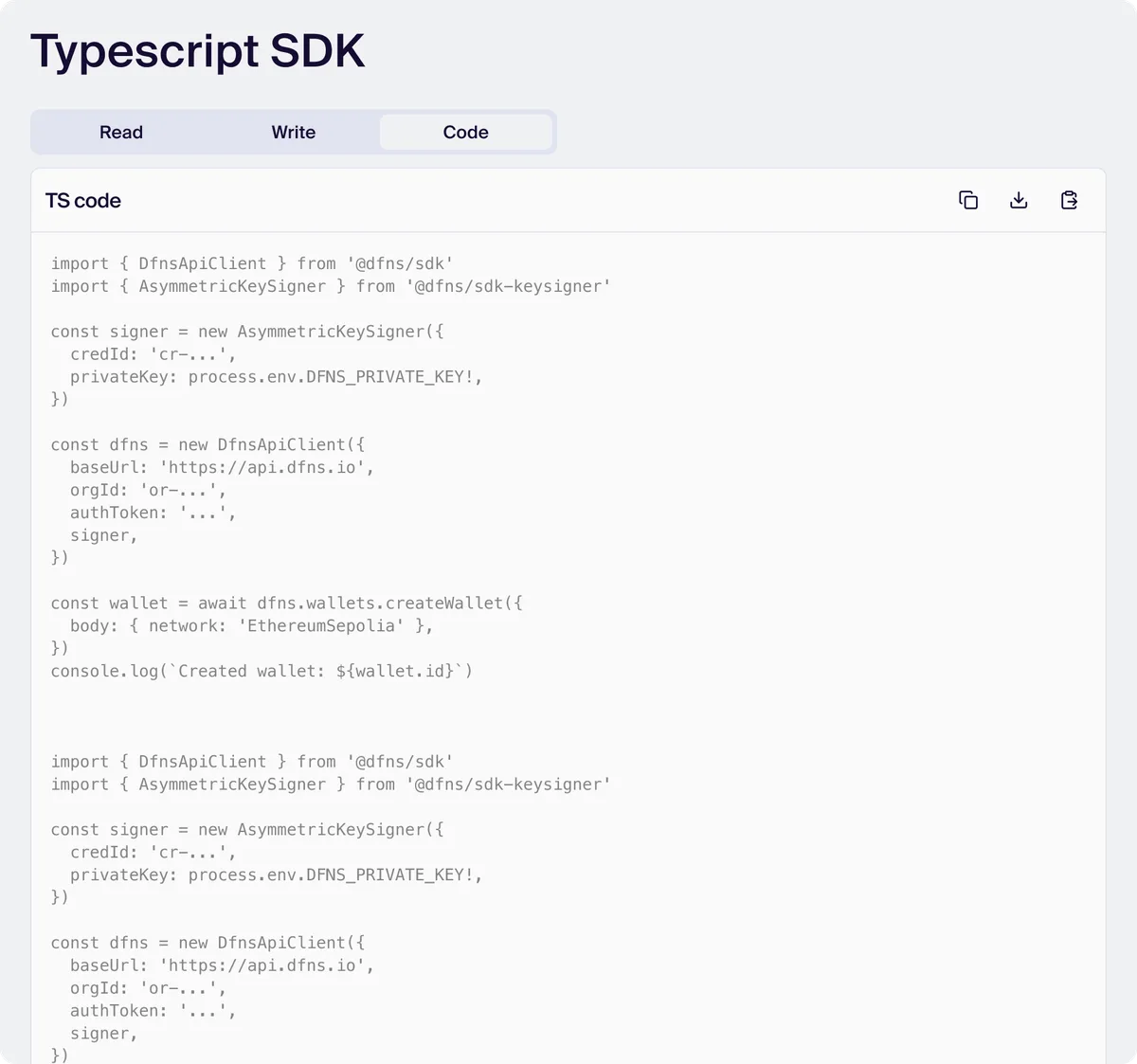
Service accounts read pending requests, decode the ABI-encoded call data, call any HTTP API or database, and post Approve / Reject / Abstain decisions. Plain TypeScript. No DSL. Your business rules, your code.
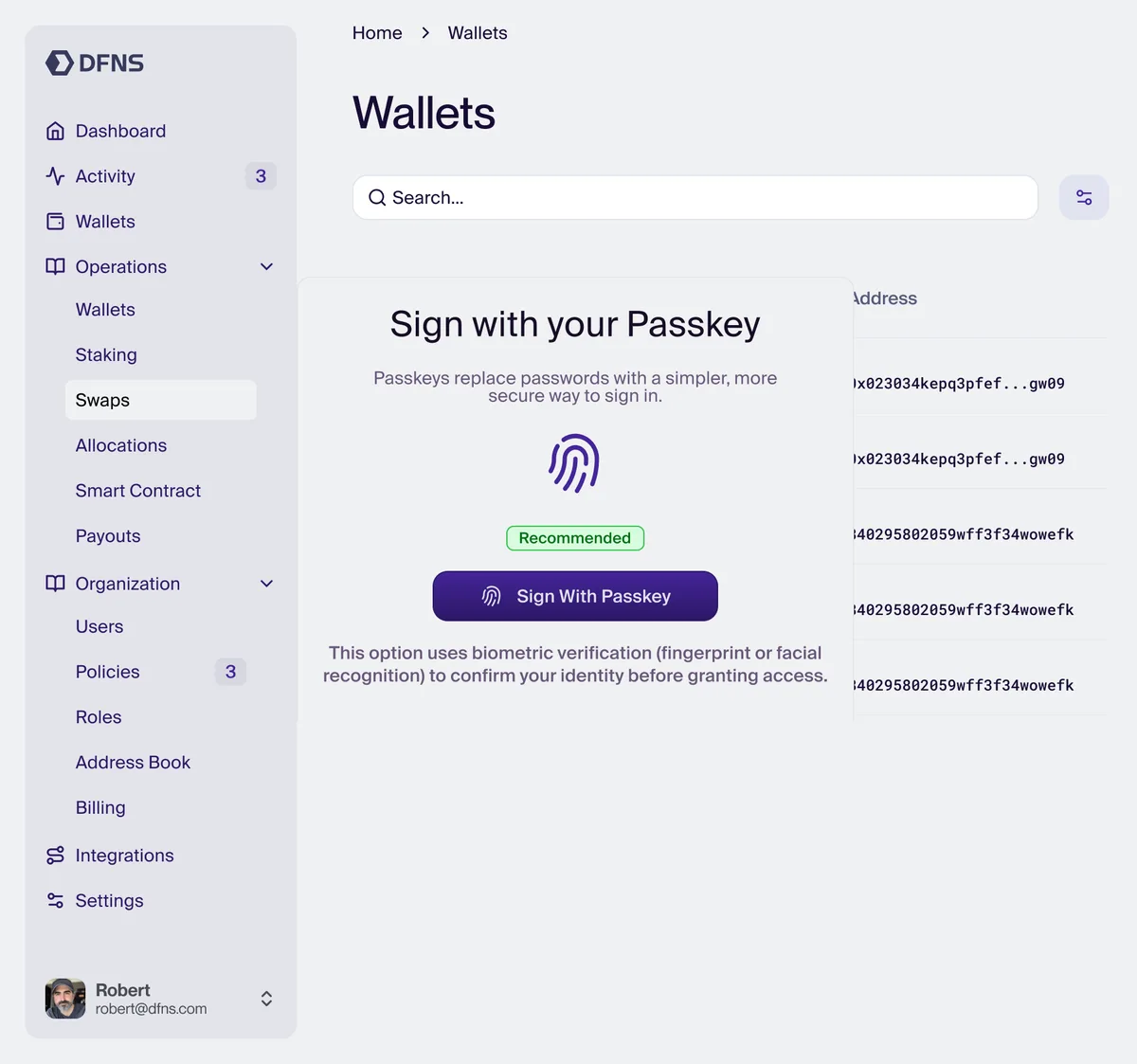
Initiators and approvers are distinct identities. The platform enforces separation of duties cryptographically — no self-approval, no shortcuts. The four-eyes principle, encoded.
Decode any smart contract call. Apply per-function rules. Allow mint to whitelisted recipients only. Cap transfer per call. Reject unknown selectors. Sanctions-screen any address.
Service accounts handle the 95% routine. Humans handle the 5% exceptions. Abstain when uncertain — humans in the same approval group take it from there. Auto-escalation, not auto-rejection.
Every step,
signed and logged
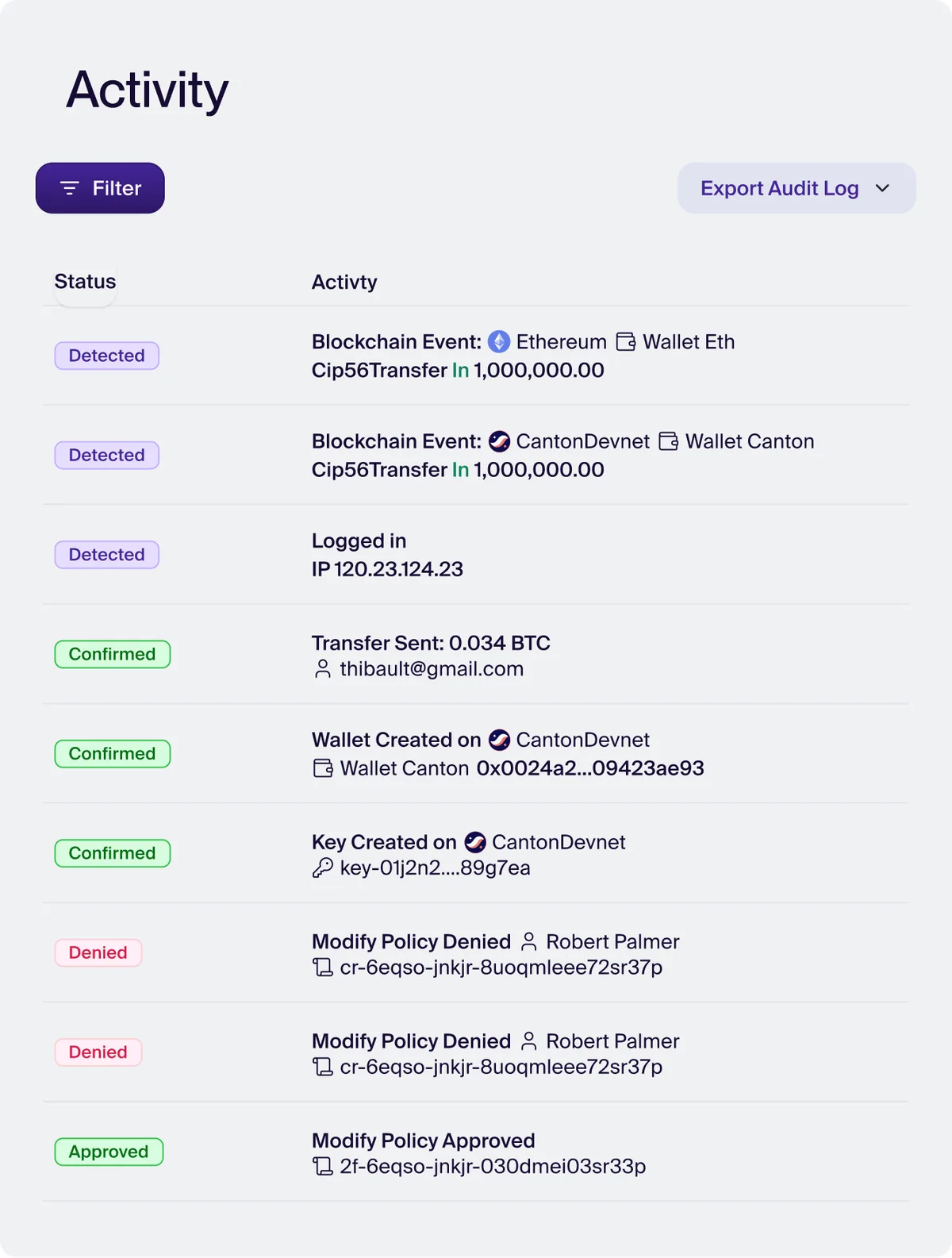
Every action — initiated, approved, signed, broadcast — is cryptographically attributed and stored. Non-repudiation by construction. Auditors and regulators read the same logs your ops team does.
Every decision is signed by the identity that made it. Service account or human, the chain of custody is unbroken and verifiable.
Filter by user, wallet, policy, contract, date. Export to CSV. Stream to your SIEM. Query through the API. The audit trail lives where you need it.
SOC2, ISO 27001. The audit trail satisfies internal and external review. No reconstruction, no excuses, no Excel exports.
Discover how Nilos runs operations on DFNS.
“As a regulated custodian committed to the highest standards of compliance, our partnership with DFNS has been crucial. Their security best practices, programmatic developer tools, and robust infrastructure help us carry out carefully controlled operations. We also appreciate their team as they provide responsive support and sub-hour troubleshooting.”


Four steps to a workflow that runs itself
Provision a service account. Subscribe to the events that matter. Codify the decisions. Audit everything. Production-ready in days.
Service accounts handle 95%+ of routine operations · Webhooks fire within milliseconds · Every action cryptographically signed · 0 lost events
Spin up a service account, scoped to one job.
A machine identity with the narrowest permission set that does the job. One service account per workflow. One per environment. One per failure radius.
// Create a scoped service account for your settlement workflow
const checker = await dfnsApi.auth.createServiceAccount({
  body: {
    name: "settlement-checker-prod",
    publicKey: "-----BEGIN PUBLIC KEY-----\n...\n-----END PUBLIC KEY-----",
    permissionId: "pm-settlement-checker-v1",  // approve-only, no broadcast
    daysValid: 365
  }
});

// checker.id, checker.accessToken — credentials go to your secret store
// This identity can read pending approvals and post decisions. Nothing else.Wire webhooks to the events that drive the workflow.
Subscribe once to the events that matter. DFNS delivers them signed and idempotent. Your handler is whatever you want it to be — a Lambda, a worker, a cron job, an Express endpoint.
// React to every event that matters to settlement
await dfnsApi.webhooks.createWebhook({
  body: {
    url: "https://workflows.yourbank.com/dfns/events",
    events: [
      "policy.approval.pending",           // a transaction needs a decision
      "wallets.transfer.confirmed",        // settlement landed, post to ledger
      "wallets.transfer.failed",           // settlement failed, escalate
      "wallets.transaction.broadcasted"    // broadcast confirmed, update CRM
    ]
  }
});

// Webhooks are signed (verify the X-Dfns-Signature header) and idempotent
// Deduplicate on deliveryId — at-least-once, never lessCodify the business rules. Approve, reject, or abstain.
Service accounts read the pending approval, decode the call data, run your rules, and post a decision. Approve when sure. Reject when malicious. Abstain when uncertain — humans take it from there.
// On 'policy.approval.pending' — your handler runs
async function onApprovalPending(event) {
  const approval = await dfnsApi.policies.getApproval({ approvalId: event.approvalId });
  const { to, data } = approval.activity.transactionRequest.requestBody;

  // Always validate the contract is in your allowlist BEFORE decoding
  if (!CONTRACT_ALLOWLIST.has(to.toLowerCase())) {
    return abstain(approval.id);  // human reviews, don't auto-reject
  }

  const decoded = decodeFunctionData({ abi, data });

  if (decoded.functionName === "mint") {
    const [recipient, amount] = decoded.args;
    const sanctionsHit  = await sanctions.check(recipient);           // any API
    const dailyMinted   = await ledger.getMintedToday(approval.activity.walletId);

    if (sanctionsHit)                          return reject(approval.id, "Sanctions match");
    if (amount > MAX_PER_TX)                   return abstain(approval.id);  // escalate
    if (dailyMinted + amount > DAILY_CAP)      return abstain(approval.id);

    return approve(approval.id, "Mint within policy");
  }

  return abstain(approval.id);  // unknown function, human decides
}Review, export, prove.
Every decision is signed by the identity that made it. Every event is queryable. Pull last month's decisions in one call. Stream them into your SIEM. Hand them to your auditor without screenshots.
// Every decision is signed and queryable
const decisions = await dfnsApi.policies.listApprovalDecisions({
  query: {
    approverId: "sa-settlement-checker-prod-...",
    dateFrom: "2026-05-01",
    dateTo: "2026-05-31"
  }
});

// decisions.items[i] — id, approvalId, decision, reason, signature, timestamp
// Pipe to your audit warehouse, your SIEM, your monthly compliance report
// Verify signatures end to end if you need to prove provenance independently